Showing posts with label social studies. Show all posts
Showing posts with label social studies. Show all posts
Monday, 30 May 2016

Sunday, 10 January 2016
Egypt museum project

1. I think that as an individual I feel like I did pretty well with helping Isabel with setting up the canopic jars with the lids in a pretty good order. As a group I feel like we did pretty well with working together to accomplish our interactive activity successfully but I think that we could've been more organized.
2. As an individual in the start I feel like I was trying really hard to do it well so I think that I pushed everyone including myself a little too much, but a while later I relaxed a little and didn't give as much feedback as before. So in the end I was fine. As a group member I think that we all were nervous but all understood our artifact very well so we did pretty well. In the middle, my group members and I started to get frantic because we had so many people to talk to but in the end, I think that we all cooled down and were fine.
3. I struggled with speaking loud enough with the noise around me because of all the other people talking. I think that through the rush I also tried to speak a little fast so that they wouldn't get bored and leave although I think that I was understandable.
4. I am most proud of my dialogue as well as Cornell notes because I worked very hard and I had a lot of information. For my notes I also researched a lot and for my dialogue I narrowed the most important information.
5. I think that in my overall experience I will remember me presenting in the library for the actual Egypt museum the most because of the thrill and the conflicts that arose as well as the rush of actually doing the thing that I had worked on for a really long time and worked super hard on.
Monday, 27 April 2015
Push and Pull factors reflection for Colinization
We have been studying the various groups of people that migrated from one country to another. All of these people had one thing in common, they settled to a British colony. Today, America and Singapore are no longer British colonies.
Even though these people are separated by hundreds of years and geographically went to very different places, they had many things in common. The reasons that were similar for people to leave their homeland were that they all wanted a new place to live, they were curious. They all wanted some sort of business to make money. After they lived in Singapore and America for a while whether they were forced or they wanted too, all the Singaporeans wanted to continue staying in Singapore, and all of the Americans wanted to continue staying in America.
The most interesting I learnt was that even though India, America, Europe, and other places are so far from each other yet they all experienced the same thing in a way - moving to a new place which was Singapore or America.
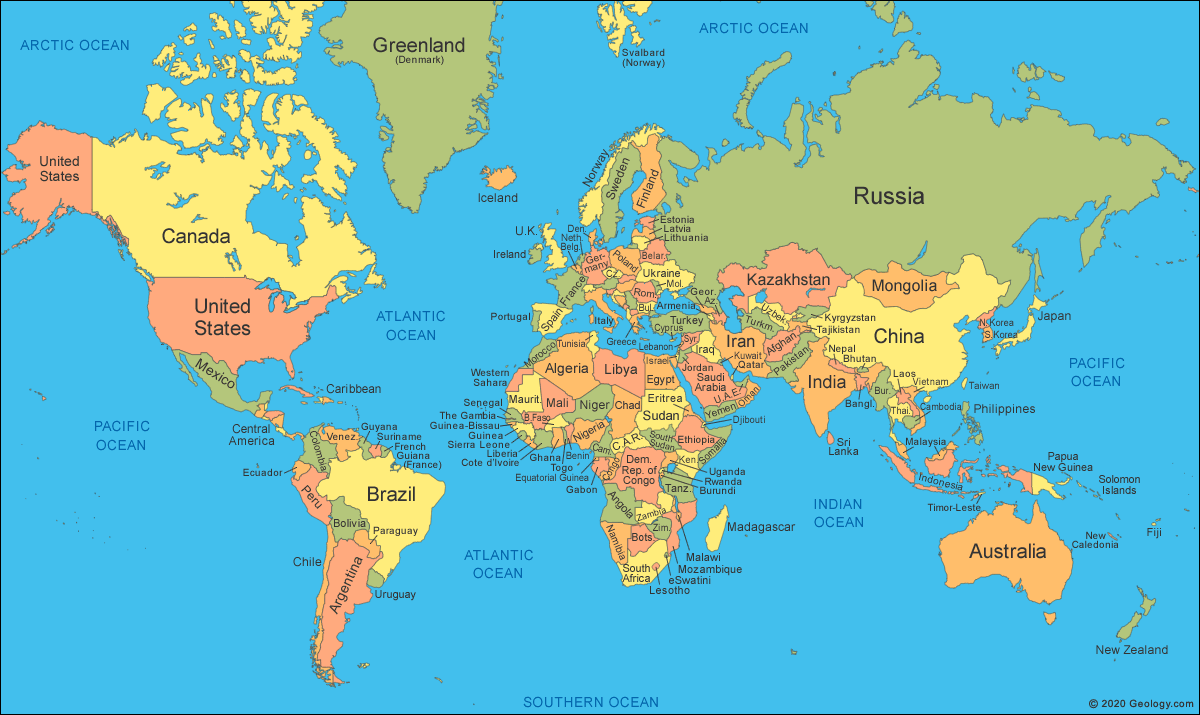
Even though these people are separated by hundreds of years and geographically went to very different places, they had many things in common. The reasons that were similar for people to leave their homeland were that they all wanted a new place to live, they were curious. They all wanted some sort of business to make money. After they lived in Singapore and America for a while whether they were forced or they wanted too, all the Singaporeans wanted to continue staying in Singapore, and all of the Americans wanted to continue staying in America.
The most interesting I learnt was that even though India, America, Europe, and other places are so far from each other yet they all experienced the same thing in a way - moving to a new place which was Singapore or America.
Wednesday, 22 April 2015
Archeologist Visit to Grade 5
Today, Jon Cooper, an Archeologist will be visiting us. He will be teaching us about World War II in Singapore, and how he researches historical events.
3 questions that I would like to find out about are:
1. What does Jon Cooper find?
2. What did Jon Cooper find that was 1,000 years old?
3. Does Jon Cooper have anyone in the generations who participated in World War II? Does he know anyone in the generations/not in the generations who used Fullerton Hotel?
For question number one, he finds bullets, guns, water bottles, and a few other things.
For question number two, he found a few bullets and a water bottle that were about 1,000 years old.
For question number three, the question wasn't answered but I don't think that he had any generations.
Something I learnt and found interesting was the bukit timah.(you don't wanna know)
3 questions that I would like to find out about are:
1. What does Jon Cooper find?
2. What did Jon Cooper find that was 1,000 years old?
3. Does Jon Cooper have anyone in the generations who participated in World War II? Does he know anyone in the generations/not in the generations who used Fullerton Hotel?
For question number one, he finds bullets, guns, water bottles, and a few other things.
For question number two, he found a few bullets and a water bottle that were about 1,000 years old.
For question number three, the question wasn't answered but I don't think that he had any generations.
Something I learnt and found interesting was the bukit timah.(you don't wanna know)
Wednesday, 8 April 2015
13 Colonies Choice
If I lived in the 1600's and I could choose what one of the thirteen colonies I could live in(settle in) I would choose Pennsylvania because of the environment which has clear waters for fishing, rich soils for farming, and mountains to explore. It also had a voting policy which I think was fair for the country though only men could vote I assume that later on the women were allowed to vote as well.
 |
| Pennsylvania in 1600's |
Monday, 30 March 2015
Sunday, 1 February 2015
How do I know what I know?
I knew some of the fifty states of America where I only knew Texas and New York because Texas is very big and New York is a very popular place so I searched it up and found out where it was located.

I knew some of the countries in Southeast Asia because I live in Southeast Asia so I wanted to find out where I lived.
I would like to know the fifty states of America by heart because it will then be much easier to answer a question about America using the fifty states. I would also be able to pronounce some of them properly.
Thursday, 22 January 2015
National Museum of Sinagapore
We went to the National museum of Singapore for our social studies unit as we are studying Singapore history.
The most interesting part of the field trip was learning about how Singapore was in the beginning and now how far it has become because Singapore is now so independent that it is hard to believe how it had once been slaved by quite a lot of countries.
The most interesting part of the field trip was learning about how Singapore was in the beginning and now how far it has become because Singapore is now so independent that it is hard to believe how it had once been slaved by quite a lot of countries.
Something that I didn't know before was that Singapore used to be ruled by Malaysia, China, India, and America in very different and interesting times. To show that Singapore has been slaved by those countries they have named a part of Singapore after them like India as Little India. I also didn't know that Singapore is a trading post(they deliver goods) that's why Singapore is so expensive. 
Wednesday, 21 January 2015
Wednesday, 14 January 2015
Social studies
A primary source is an original copy of the artifact or text. It is a first - hand account which is used as building blocks to create stories from the past. If they are reporting something the reporter has to be in the time - frame or saw, was there, when the event took place.
A secondary source is an artifact or text that has been edited or thoughts of another person have been added. Secondary items are made after the primary source. Secondary sources have been evaluated.
This is important for me to know because I can now tell if I'm reading an original copy of a book or am reading an edited version. I also need to know primary sources and secondary sources for the social studies museum(need to know the difference)

A secondary source is an artifact or text that has been edited or thoughts of another person have been added. Secondary items are made after the primary source. Secondary sources have been evaluated.
This is important for me to know because I can now tell if I'm reading an original copy of a book or am reading an edited version. I also need to know primary sources and secondary sources for the social studies museum(need to know the difference)
Subscribe to:
Posts (Atom)
Blog 12: Sustainable Cities
NeWater desalinates and recycles water ( https://www.pub.gov.sg/watersupply/fournationaltaps/newater ) Renewable energy: solar farm ( https:...
